

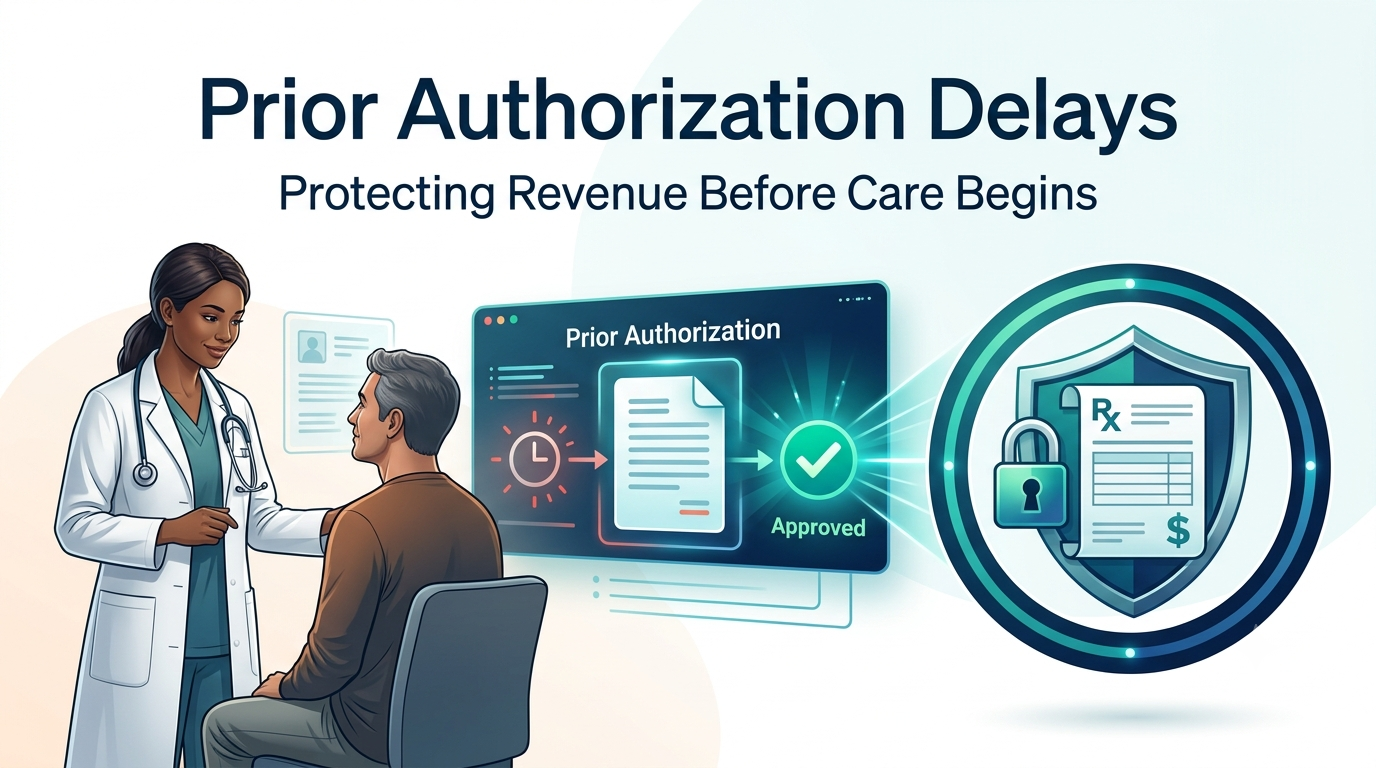
For healthcare providers, revenue leakage does not always begin with a denied claim.
Sometimes, it begins before the patient receives care.
A service is scheduled. A patient is eligible. The provider is ready to deliver care. But the required prior authorization is still pending, incomplete, incorrect, or tied to the wrong service.
The result can be a delayed start of care, rescheduling, administrative rework, an authorization-related claim denial, delayed reimbursement, or—if the issue is never corrected—revenue that becomes difficult to recover.
For providers serving Medicare and Medicaid patients, prior authorization has become an increasingly important part of the revenue cycle. CMS has taken steps to streamline prior authorization and, beginning primarily in 2026, requires certain impacted payers to respond to standard requests within seven calendar days and expedited requests within 72 hours. The affected payers include Medicare Advantage organizations and Medicaid programs and managed care plans covered by the rule.
But faster payer response times do not eliminate the provider’s responsibility.
A request can still be delayed because the provider submitted incomplete information, used the wrong service information, missed an authorization requirement, or failed to connect the authorization to the actual service being delivered.
That is why prior authorization should not be treated as a separate administrative task.
It should be treated as an upstream revenue-cycle control.
What Is Prior Authorization?
Prior authorization is a payer’s review of a proposed healthcare service before the service is provided.
Depending on the payer, plan, service, and state, the provider may need to submit information such as:
- Patient/member information
- Diagnosis
- Requested service
- Service frequency and duration
- Clinical documentation
- Medical necessity information
- Provider information
- Procedure or service codes
- Supporting records
- Start and end dates
- Number of authorized units or visits
The payer then determines whether the requested service meets its applicable coverage and authorization requirements.
If authorization is approved, the provider can proceed according to the approved terms.
If it is denied, returned for additional information, or approved with limitations, the provider may need to correct the request, provide additional documentation, or appeal.
This creates a critical revenue-cycle dependency:
If authorization is wrong, the claim may be wrong before the claim is even created.
Why Prior Authorization Is a Revenue Problem
Prior authorization is often viewed as a utilization-management process.
For a provider, it is also a revenue protection process.
Consider a simple example.
A home health provider receives a referral for a Medicare Advantage member.
The provider schedules services and assigns staff.
The authorization request is submitted.
But the request contains the wrong service information.
The payer requests clarification.
The provider does not identify the issue until several days later.
The start of care is delayed.
The patient is rescheduled.
Staff time is spent following up.
The authorization is eventually approved.
But now the original schedule has changed, the service timeline has shifted, and the billing team has to ensure that the final authorization matches the services actually delivered.
Nothing about this looks like a traditional “claim denial.”
Yet revenue-cycle disruption has already occurred.
The Real Cost of an Authorization Delay
The financial impact of authorization problems is broader than a denied claim.
1. Delayed Revenue
If an authorized service cannot begin or cannot be billed correctly, payment moves further into the future.
Even when the claim is eventually paid, the provider may experience:
- Longer days in AR
- Delayed cash flow
- Additional follow-up
- Increased administrative workload
For providers operating on thin margins, the timing of revenue matters almost as much as the final reimbursement.
2. Missed or Delayed Services
When authorization is not ready before the scheduled service, the provider may have to reschedule care.
This creates operational problems:
- Staff schedules change
- Patient visits move
- Capacity is wasted
- Routes may need to be rebuilt
- Care continuity can be affected
For home-based providers, a missed or delayed visit can create a ripple effect across the schedule.
3. Administrative Rework
Authorization problems require people to investigate them.
Someone has to:
- Check the payer portal
- Contact the payer
- Review the authorization
- Compare it with the order
- Review the patient’s record
- Correct the request
- Upload additional documentation
- Track the response
- Update the authorization record
- Notify operations
- Ensure billing has the correct information
One authorization issue may take only a few minutes.
Hundreds of them can consume significant staff capacity.
4. Claim Denials
This is where the problem becomes visible to the traditional RCM process.
A provider may deliver a service believing everything is in place.
The claim is submitted.
The payer responds:
Authorization missing.
Or:
Authorization does not cover the billed service.
Or:
Units exceed authorization.
Or:
Dates of service fall outside the authorization period.
Now the billing team has inherited a problem that should have been caught earlier.
Prior Authorization Is Not the Same Across Medicare
One of the most important points for providers is that Medicare does not have one universal prior authorization process for every service.
The rules depend on the Medicare program and service.
Medicare Advantage
Prior authorization is commonly part of the utilization-management process used by Medicare Advantage organizations.
CMS’s 2024 Interoperability and Prior Authorization Final Rule established requirements for impacted payers, including Medicare Advantage organizations, to streamline prior authorization. For applicable medical items and services, the rule sets maximum response times of seven calendar days for standard requests and 72 hours for expedited requests.
For providers, that creates an important operational expectation:
The authorization process should be tracked with the same discipline as the claim process.
A request should not simply be submitted and forgotten.
Medicare Fee-for-Service Is Different
Traditional Medicare Fee-for-Service does not require prior authorization for every service.
However, CMS operates specific prior authorization and pre-claim review initiatives for certain services and providers.
CMS explains that prior authorization occurs before the service is rendered, while pre-claim review occurs before the claim is submitted and may allow the service itself to be provided before the review request is submitted.
For home health providers, the Review Choice Demonstration (RCD) is particularly relevant in participating states.
Under the RCD, participating home health agencies can choose options that include pre-claim review or postpayment review. CMS extended the demonstration for five years beginning June 1, 2024, in the participating states of Illinois, Ohio, Texas, North Carolina, Florida, and Oklahoma.
This is an important distinction:
Do not treat Medicare Fee-for-Service and Medicare Advantage authorization requirements as interchangeable.
Your RCM process needs to understand the payer and program before deciding what validation is required.
Medicaid Is Even More Complex
Medicaid creates another layer of complexity because requirements can vary by state, program, managed care plan, service, and member.
A Medicaid provider may need to deal with:
- State Medicaid requirements
- Medicaid managed care organizations
- Service-specific authorization rules
- Plan-specific requirements
- Unit limitations
- EVV requirements
- Service codes
- Authorization periods
- Provider enrollment requirements
CMS’s prior authorization rules now establish response-time requirements for applicable state Medicaid fee-for-service programs and Medicaid managed care plans, including maximum timeframes of seven calendar days for standard requests and 72 hours for expedited requests, subject to the applicable rules.
But response time is only one part of the problem.
Providers still need to submit the right information to the right payer for the right service.
The Authorization-to-Claim Connection
The biggest RCM mistake is treating authorization as a document that sits separately from billing.
It should be connected directly to the service and claim lifecycle.
Think about the flow:
Patient Eligibility
↓
Referral / Order
↓
Authorization Required?
↓
Authorization Request
↓
Authorization Approved
↓
Authorized Service / Units / Dates
↓
Care Delivered
↓
EVV / Visit Validation
↓
Claim Validation
↓
837 Claim
↓
Payer Adjudication
↓
835 / Payment
If the authorization information does not flow through this process, billing teams are forced to manually reconstruct the relationship later.
That is where errors occur.
What Can Go Wrong Between Authorization and Claim?
A provider may have an authorization, but that does not necessarily mean the claim is protected.
Several mismatches can occur.
Member mismatch
The authorization belongs to one member, but the claim is associated with another member ID.
Service mismatch
The authorized service is different from the service being billed.
Code mismatch
The authorization uses one service code while the claim uses another.
Unit mismatch
The provider bills more units than were authorized.
Date mismatch
The service occurs outside the authorization period.
Provider mismatch
The authorization is associated with a provider or rendering entity that does not match the claim requirements.
Payer mismatch
The patient changes plans, but the provider continues using outdated authorization information.
Expired authorization
The provider continues delivering services after the authorization period ends without confirming a renewal.
These are not merely billing problems.
They are data-integrity problems across the revenue cycle.
The Most Dangerous Authorization Problem: Silent Expiration
One of the most common operational risks is an authorization that simply expires.
Imagine:
Authorization: January 1 – March 31
The provider continues delivering services in April.
The care is legitimate.
The patient still needs the service.
The caregiver completes the visits.
But the authorization has expired.
If the renewal was not obtained in time, April’s services may now require investigation, correction, or additional payer action.
This is why authorization management should include forward-looking alerts, not just historical reporting.
The system should know:
- Which authorizations expire in 30 days?
- Which expire in 14 days?
- Which expire in 7 days?
- Which services are approaching authorized unit limits?
- Which patients are scheduled after authorization expiration?
- Which visits are being delivered against an authorization nearing exhaustion?
The goal is to identify the problem before the service becomes financially risky.
Authorization Should Be Validated Before Scheduling Care
A strong revenue-cycle process does not wait until billing to discover authorization problems.
Before care begins, the provider should validate:
Member
Is the correct member identified?
Eligibility
Is coverage active for the intended date of service?
Payer
Is the correct payer/plan identified?
Service
Does the requested service match the service that will actually be delivered?
Authorization
Is authorization required?
Authorization Status
Has it been approved?
Dates
Does the authorization cover the planned service dates?
Units
Are enough units or visits available?
Provider
Is the appropriate provider associated with the authorization?
Documentation
Is the supporting documentation complete?
Billing Configuration
Can the authorization information be correctly mapped to the eventual claim?
This is essentially pre-billing validation performed before care begins.
The Role of EVV
For applicable Medicaid personal care and home health services, EVV adds another important layer.
CMS requires EVV systems to verify information including the individual receiving the service, the provider, the service type, date, start and end time, and location.
That means providers should think about authorization and EVV together.
For example:
Authorization
20 hours of personal care per week
↓
Scheduled
20 hours
↓
EVV
22 hours recorded
↓
Validation
2 hours exceed the expected authorized amount
↓
Exception
Billing team investigates before claim submission
Without this type of control, the provider may discover the mismatch only after the payer receives the claim.
Prior Authorization and Medical Necessity
Authorization is not simply about obtaining a reference number.
The payer may need information supporting why the requested service is appropriate.
This is particularly important for Medicare home health.
CMS states that Medicare home health eligibility includes requirements such as being homebound, being under the care of a physician or allowed practitioner, receiving services under a plan of care, and needing qualifying skilled services. CMS also requires supporting documentation to justify the referral, including the patient’s need for skilled services and homebound status.
For providers, this means the authorization workflow should not be separated from clinical and supporting documentation.
A number alone does not guarantee a clean claim.
The authorization, documentation, service delivered, and claim must tell the same story.
What Recent Medicare Advantage Findings Tell Providers
Prior authorization problems are not theoretical.
In a 2026 report, the HHS Office of Inspector General examined Medicare Advantage prior authorization requests for skilled nursing facility admissions. Among the 19 MA organizations reviewed, 12% of requests were denied in June 2024. Of the denials that were appealed, MA organizations overturned 95% in favor of the enrollee.
The finding is important for providers for two reasons.
First, an initial authorization denial does not necessarily mean the requested care is inappropriate.
Second, providers need a structured process for identifying questionable denials, supplying supporting information, and escalating or appealing when appropriate.
Another OIG review found that 13% of sampled Medicare Advantage prior authorization denials met Medicare coverage rules. OIG also identified documentation and clinical-criteria issues in some cases.
The lesson is not that providers should challenge every authorization decision.
The lesson is:
Authorization decisions need visibility, documentation, tracking, and an organized response process.
Build an Authorization Workbench, Not a Spreadsheet
Many providers still manage authorization information through spreadsheets, email, payer portals, and disconnected systems.
That creates several problems.
A billing or authorization specialist may know that an authorization is expiring.
The scheduler may not.
The caregiver may not.
The claims team may not.
The RCM system may not.
That creates a disconnected workflow.
A better approach is an Authorization Workbench that brings the relevant information together.
For each authorization, the team should be able to see:
- Patient/member
- Payer
- Plan
- Service
- Authorization number
- Effective date
- Expiration date
- Authorized units
- Used units
- Remaining units
- Status
- Documentation status
- Related visits
- Related claims
- Exceptions
- Renewal status
- Responsible staff member
This changes authorization from a static record into an active revenue-control workflow.
Use Risk-Based Alerts
Not every authorization requires the same level of attention.
An effective RCM system can prioritize risk.
For example:
High Risk
- Authorization expired
- Service scheduled after expiration
- No authorization on file
- Units already exceeded
- Payer mismatch
- Authorization denied
Medium Risk
- Authorization expires within 7 days
- 90% of authorized units consumed
- Documentation incomplete
- Renewal pending
Low Risk
- Authorization active
- Adequate units remaining
- All required documentation complete
- No upcoming expiration risk
This helps staff focus on the authorizations most likely to affect revenue.
How Revenue Catalyst AI Can Help
This is where an integrated RCM platform can move authorization management from a manual task to a revenue-protection workflow.
Revenue Catalyst AI can connect authorization information with the broader revenue cycle:
Eligibility
→ Authorization
→ Service / Visit Data
→ EVV Validation
→ State & Payer Rules
→ Claim Validation
→ 837 Generation
→ Claim Submission
→ 835 Response
→ Denial Management
→ AR & Revenue Recovery
Instead of asking the billing team to discover authorization problems after a claim is denied, the system can surface issues earlier in the workflow.
For example:
Authorization expires in 5 days. 12 scheduled services fall outside the current authorization period.
Or:
8 visits have been recorded against an authorization with only 5 units remaining.
Or:
Claim service code does not match the authorized service.
These are much more useful alerts than simply reporting:
Claim denied — authorization issue.
The first alerts give the provider an opportunity to prevent the problem.
The second tells the provider that revenue has already been affected.
Prevention Is Better Than Authorization Recovery
There are two ways to approach authorization-related revenue problems.
Reactive RCM
Service → Claim → Denial → Investigation → Appeal → Payment
This approach relies on the payer to identify the problem.
Preventive RCM
Eligibility → Authorization → Validation → Service → Claim → Payment
This approach identifies risk before the claim reaches the payer.
Neither approach eliminates every denial.
But preventive controls can reduce avoidable errors and make the billing team more proactive.
The objective is not to eliminate every payer decision.
It is to eliminate provider-controlled errors before submission.
Five Authorization Metrics Every Provider Should Track
Authorization management should be measurable.
1. Authorization Approval Rate
How many submitted requests are approved without additional action?
2. Average Authorization Turnaround Time
How long does it take from request submission to decision?
3. Authorization Exception Rate
What percentage of services encounter authorization-related issues?
4. Authorization-Related Denial Rate
How many claims are denied because of authorization problems?
5. Revenue at Risk
How much potential reimbursement is associated with services affected by authorization problems?
The fifth metric is especially important.
A provider could have a low authorization exception rate but still have significant revenue exposure if the affected services are high-value.
Don’t Measure Authorization Only by Volume
Suppose Provider A has:
100 authorization issues
Potential revenue affected:
$5,000
Provider B has:
20 authorization issues
Potential revenue affected:
$50,000
Provider B has fewer issues.
But Provider B has a much larger financial risk.
That is why authorization dashboards should show both:
Issue Count + Financial Impact
This allows revenue-cycle leaders to prioritize what matters most.
A Better Pre-Care Revenue Checklist
Before care begins, the RCM workflow should be able to answer:
Patient
- Is the member eligible?
Payer
- Is the correct payer and plan identified?
Service
- Is this service covered?
Authorization
- Is prior authorization required?
- Has it been approved?
Dates
- Does the authorization cover the planned service period?
Units
- Are sufficient units available?
Documentation
- Is the supporting information complete?
Provider
- Is the provider correctly associated?
EVV
- If applicable, can the visit data be validated against the authorization?
Billing
- Can the approved service be mapped correctly into the claim?
If any of these answers is unclear, the revenue risk should be visible before care begins.
The Future of Prior Authorization Is More Connected
CMS’s recent policy direction points toward more electronic and standardized prior authorization workflows.
The 2024 CMS Interoperability and Prior Authorization Final Rule requires impacted payers to implement a Prior Authorization API using the HL7 FHIR standard, with the goal of supporting more efficient electronic exchange between providers and payers.
For providers, this represents more than a technology upgrade.
It creates an opportunity to connect:
Patient → Eligibility → Authorization → Care → Claim → Payment
instead of managing each stage independently.
The long-term opportunity is to make authorization information part of the same data flow that drives the claim.
