
Every visit your caregivers complete should contribute to your agency’s financial health.
Yet many Medicare, Medicaid, home health, and personal care agencies lose thousands of dollars every month not because they aren’t providing quality care, but because revenue slips away during the billing process.
Claim denials, documentation errors, missed billing opportunities, and delayed submissions can quietly reduce cash flow and increase administrative costs. The frustrating part? Most of these revenue leaks are preventable.
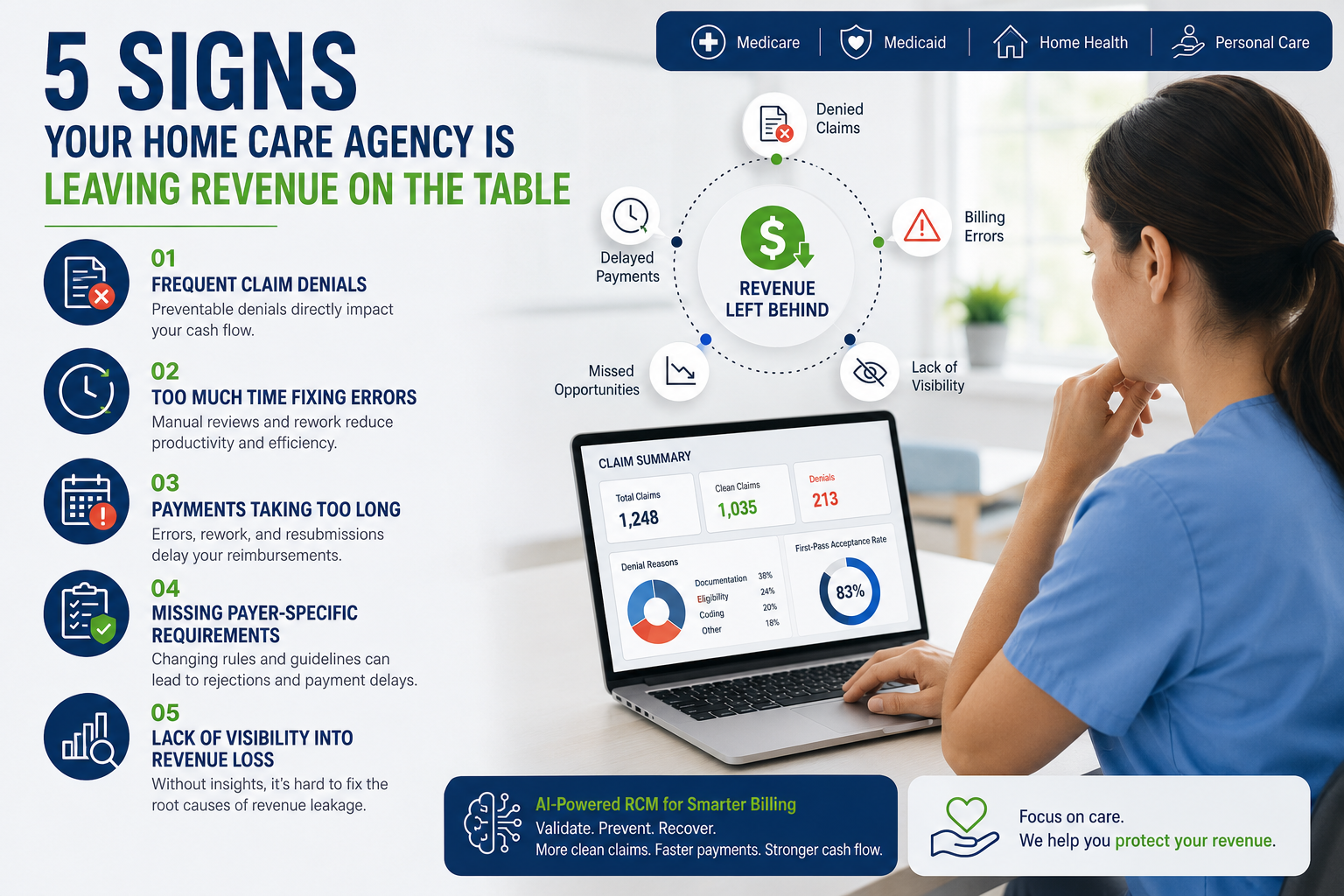
Here are five warning signs that your agency may be leaving revenue on the table—and what you can do about them.
1. You’re Experiencing Frequent Claim Denials
Claim denials are more than an administrative inconvenience they directly impact your revenue.
Many denials happen because of:
- Missing or incomplete documentation
- Coding inaccuracies
- Payer-specific billing rule violations
- Data mismatches between visits and claims
Every denied claim requires staff time to investigate, correct, and resubmit. Some claims are never recovered at all.
What this means for your agency:
- Delayed reimbursements
- Increased administrative workload
- Higher operating costs
- Reduced cash flow
Reducing preventable denials is one of the fastest ways to improve financial performance.
2. Your Billing Team Spends Too Much Time Correcting Errors
If your billing staff spends hours reviewing claims, fixing mistakes, or handling rework before submission, your billing process may be relying too heavily on manual validation.
Common issues include:
- Missing visit information
- Incorrect service codes
- Documentation inconsistencies
- Billing rule violations discovered too late
Manual reviews consume valuable time and still allow errors to slip through.
The result:
Your experienced billing professionals spend more time correcting mistakes than processing clean claims efficiently.
3. Payments Are Taking Longer Than Expected
Providing care today but receiving payment weeks—or even months—later can strain your agency’s finances.
Delayed reimbursements often stem from:
- Claims submitted with errors
- Incomplete supporting documentation
- Multiple rounds of payer corrections
- Repeated claim resubmissions
Slower payments can impact:
- Payroll
- Daily operations
- Business growth
- Cash flow planning
A smoother claim submission process helps accelerate reimbursements and improves financial stability.
4. You’re Missing Payer-Specific Billing Requirements
Medicare, Medicaid, and managed care organizations each have unique billing guidelines.
Requirements frequently change, including:
- Documentation standards
- Coding updates
- State-specific Medicaid rules
- Claim formatting requirements
Even small compliance issues can result in claim rejections or payment delays.
Agencies that rely solely on manual knowledge often struggle to keep pace with evolving payer requirements.
5. You Don’t Have Visibility Into Why Revenue Is Being Lost
Many agencies know revenue is being delayed—but they don’t know exactly where or why.
Without clear visibility, it’s difficult to answer questions like:
- Which denial reasons occur most often?
- Which claims require repeated corrections?
- Where are billing bottlenecks happening?
- Which payers generate the highest denial rates?
Without these insights, agencies often continue fixing symptoms instead of addressing the root causes.
Better visibility enables smarter decisions and continuous improvement across the revenue cycle.
How AI Can Help Prevent Revenue Leakage
Modern Revenue catalyst platforms use intelligent automation to identify billing issues before claims are submitted.
Instead of waiting for denials, AI can help:
- Validate claims before submission
- Detect missing documentation
- Identify payer-specific billing issues
- Flag coding inconsistencies
- Reduce manual rework
- Improve first-pass claim acceptance
For Medicare, Medicaid, Home Health, and Personal Care providers, this means fewer preventable denials, faster reimbursements, and a more efficient billing workflow.
Final Thoughts
Revenue loss doesn’t always come from providing fewer services—it often comes from inefficiencies hidden within the billing process.
If your agency is experiencing frequent denials, delayed reimbursements, excessive manual corrections, or limited visibility into billing performance, it may be time to evaluate your revenue cycle.
By identifying these warning signs early and adopting smarter billing practices, home care agencies can strengthen cash flow, improve operational efficiency, and focus more on delivering quality patient care.
About RevenueCatalyst AI
RevenueCatalyst AI is an AI-powered Revenue Management platform designed specifically for Medicare, Medicaid, Home Health, and Personal Care providers.
Working alongside your existing EHR and billing systems, it helps agencies identify billing issues before claim submission, reduce preventable denials, improve first-pass claim acceptance, and accelerate reimbursements without disrupting existing workflows.
