

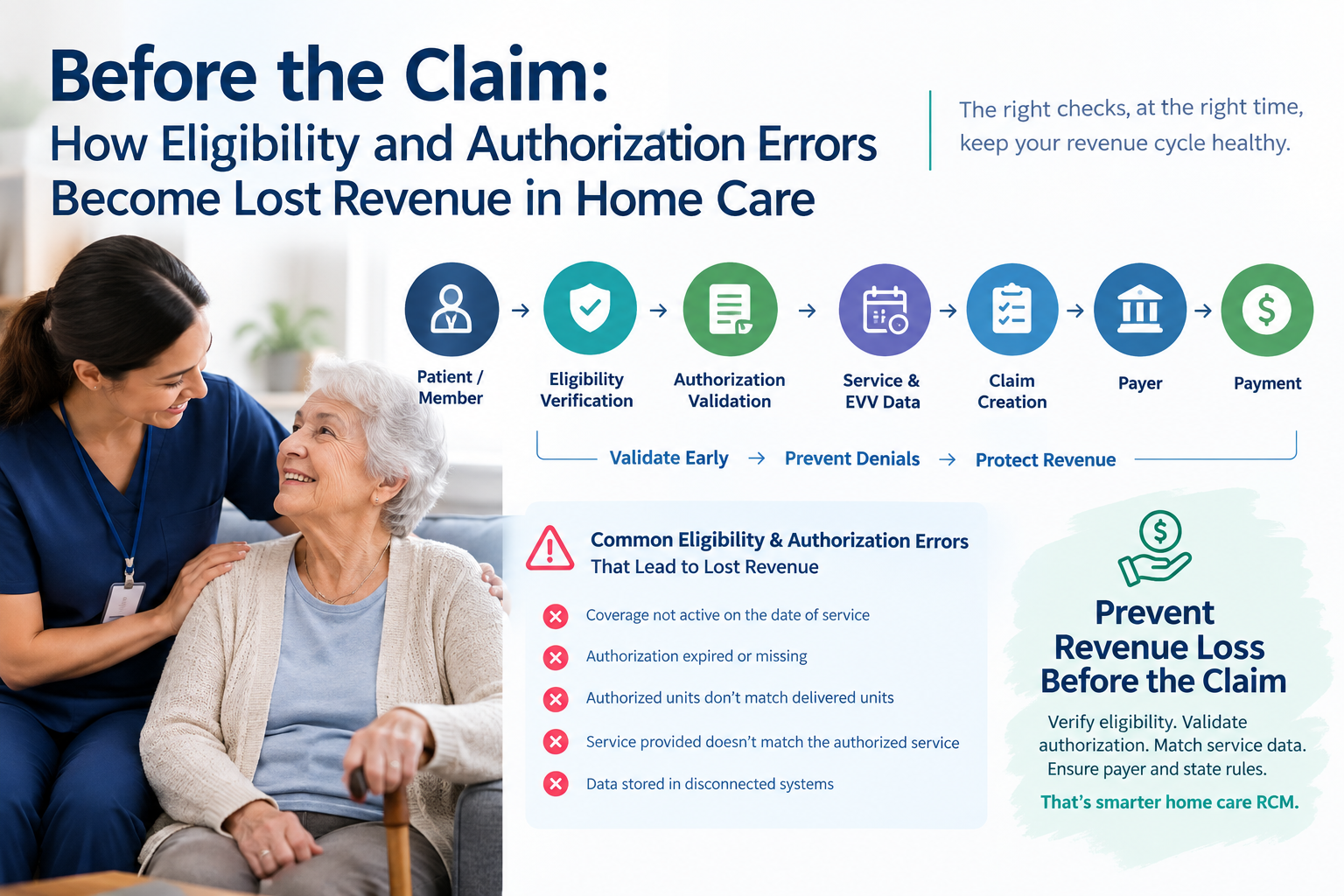
For a home care agency, revenue loss does not always begin with a denied claim.
In many cases, the problem starts much earlier—before a claim is ever created.
A patient may appear eligible for services, but their coverage may have changed. An authorization may have expired. The authorized units may not match the services delivered. A payer may require specific documentation, service codes, or authorization details that were not captured correctly.
By the time the billing team discovers the problem, the caregiver may have already delivered the service and the agency may already have incurred the cost.
This is why effective revenue cycle management (RCM) begins before the claim.
The goal is not simply to submit more claims. It is to make sure the data behind those claims is accurate, supported, authorized, and ready for billing.
Why Eligibility and Authorization Matter to Home Care Revenue
Home care revenue depends on a chain of events working correctly:
Patient → Eligibility → Authorization → Service → Visit Data → Validation → Claim → Payer → Payment
A problem at any early stage can affect everything that follows.
For example:
A Medicaid member is scheduled for 20 hours of personal care services per week. The agency’s system still shows an older authorization for 12 hours. The caregiver provides 20 hours, but only 12 hours may be supported by the authorization on file. The billing team submits the claim without identifying the mismatch.
The problem is not necessarily the claim format.
The problem started when authorized service information and delivered service information were not aligned.
This distinction is important because many RCM teams focus heavily on what happens after a claim is submitted. A stronger process also asks:
Was this service billable before we created the claim?
What Is Eligibility Verification?
Eligibility verification is the process of confirming that a patient or member has active coverage and that the agency’s services can potentially be billed under that coverage.
For Medicare, home health coverage has specific requirements. CMS states that eligible patients must, among other requirements, be enrolled in Medicare Part A or Part B, be under the care of a physician or allowed practitioner, receive services under a plan of care, and meet the applicable skilled-service requirements.
For Medicaid, eligibility and program requirements can vary by state and by the specific Medicaid benefit or program. CMS maintains state-specific Medicaid eligibility verification plans, reflecting the role of state Medicaid agencies in administering eligibility processes.
That means a billing team cannot always treat eligibility as a simple “active/inactive” field.
A useful eligibility check may need to answer questions such as:
- Is the member currently eligible?
- What payer or plan is responsible?
- Is the coverage active on the date of service?
- Is the provider enrolled with the payer?
- Is the specific service covered?
- Is another payer potentially responsible?
- Are there benefit limitations?
- Is authorization required?
- Does the member have managed Medicaid coverage?
- Has the patient’s coverage changed since the last visit?
The exact checks required depend on the payer, program, state, and service.
What Is Authorization?
Authorization is different from eligibility.
Eligibility asks:
“Does the patient have coverage?”
Authorization asks:
“Has the payer approved the specific service, amount, period, or other required parameters?”
A patient can have active Medicaid coverage and still have an authorization-related billing problem.
For example:
| Eligibility | Authorization | Potential Situation |
| Active | Valid | Service may proceed, subject to other requirements |
| Active | Expired | Service may not be payable under the expired authorization |
| Active | Not available | Authorization may be required before billing |
| Active | Wrong service | Delivered service may not match authorized service |
| Active | Insufficient units | Delivered units may exceed authorized units |
| Inactive | Valid authorization on old record | Coverage still needs to be verified |
This is why eligibility and authorization should be treated as separate RCM controls.
How Small Pre-Claim Errors Become Revenue Problems
Consider a typical home care workflow.
Step 1: Referral or Member Intake
The agency receives a referral and enters the patient’s information.
Step 2: Eligibility Check
The agency verifies coverage.
Step 3: Authorization
The agency receives or records authorization information.
Step 4: Care Delivery
The caregiver or clinician provides the authorized service.
Step 5: Visit Data
Service details, including dates, times, service types, units, and other required information, are captured.
Step 6: Billing
The billing system converts the validated service data into a claim.
Step 7: Claim Submission
The claim is sent to the appropriate payer.
Step 8: Adjudication
The payer evaluates the claim.
Step 9: Payment or Denial
The agency receives payment, adjustment, rejection, or denial information.
The common mistake is to think the revenue-cycle problem begins at Step 7.
It often begins at Step 2 or Step 3.
5 Eligibility and Authorization Problems That Can Put Revenue at Risk
1. Coverage Was Not Active on the Date of Service
A patient may have been eligible when services were scheduled but no longer eligible when services were actually delivered.
Coverage information can change.
For a home care agency, relying on an old eligibility check can create a gap between:
“The patient was eligible”
and
“The patient was eligible on this specific date of service.”
That distinction matters.
Example
A patient starts receiving services on June 1.
The agency verifies eligibility on May 30.
Coverage changes on June 15.
The agency continues billing services through June 30 using the original eligibility information.
The issue may not be discovered until claims are processed.
RCM lesson
Eligibility should be treated as date-sensitive information, not a one-time administrative task.
2. Authorization Has Expired
Authorization periods have defined dates and conditions.
If an agency continues providing services after an authorization expires without confirming a new authorization, the resulting services may create billing risk.
Example
An authorization covers:
June 1 – June 30
The caregiver continues providing services on July 1.
The new authorization has not yet been received.
The service may still have been clinically appropriate, but the billing team now has a question:
“What authorization supports the July 1 service?”
This is where operational delays can turn into revenue-cycle problems.
RCM lesson
Authorization expiration dates should be actively monitored rather than discovered during claim submission.
3. Authorized Units Do Not Match Delivered Units
This is particularly important for home and community-based services where services can be authorized in units or hours.
Suppose an authorization allows:
80 hours per month
but the agency’s service data shows:
92 hours delivered
The agency now has a variance that needs to be investigated.
Possible explanations could include:
- Updated authorization not entered
- Additional units approved but not recorded
- Scheduling error
- Incorrect service entry
- EVV/service data discrepancy
- Actual services exceeding the authorization
The important point is that the billing team should not simply discover this after claim submission.
RCM lesson
Compare:
Authorized Units vs. Delivered Units vs. Billable Units
before creating the claim.
4. The Service Delivered Does Not Match the Authorized Service
Authorization is not only about quantity.
The authorized service itself matters.
For example:
Authorized: Personal Care Service
Delivered: A different service code or discipline
Even when the patient is eligible and the caregiver provided legitimate care, the service may not align with what was authorized.
The mismatch could involve:
- Service type
- Procedure code
- Modifier
- Discipline
- Place of service
- Units
- Dates
- Provider
- Authorization number
The exact requirements depend on the payer and program.
RCM lesson
The billing system should validate the relationship between authorization data and service data, not just whether an authorization record exists.
5. Eligibility, Authorization, and Visit Data Are Stored Separately
This is one of the biggest operational challenges for growing home care agencies.
The information may exist—but in different places.
For example:
EHR
→ Patient information
Payer Portal
→ Eligibility
Authorization Document
→ Approved services and units
EVV System
→ Visit information
Billing System
→ Claims
Spreadsheet
→ Manual tracking
When these systems are not connected, staff may need to manually compare information.
That creates opportunities for:
- Data-entry errors
- Outdated information
- Missed expiration dates
- Duplicate records
- Incorrect units
- Unidentified mismatches
- Delayed billing
The problem is not necessarily that the agency lacks data.
The problem is that the agency lacks connected, actionable data.
Medicaid Makes This More Complex
Medicaid home and community-based services can involve state-specific requirements and program structures.
CMS notes that states have flexibility in how they define and administer certain Medicaid HCBS benefits, including state-defined criteria and services under authorities such as Section 1915(i).
This means an agency operating across multiple states cannot always assume that one billing rule applies everywhere.
The workflow may involve:
State → Medicaid Program → Managed Care Plan → Service → Authorization → EVV → Claim
For Medicaid personal care and home health services that require an in-home visit, EVV is also an important part of the service-data environment. Federal law requires states to implement EVV for applicable Medicaid-funded personal care services and home health services, with implementation requirements applying on different timelines.
CMS guidance describes EVV data elements such as the service performed, individual receiving care, individual providing care, date, location, and start/end times.
This creates another important RCM relationship:
Authorization → EVV → Service Data → Claim
If these elements do not align, the billing team may have to investigate the exception before the claim can be safely submitted.
Medicare Has Its Own Eligibility and Documentation Requirements
Medicare home health billing also demonstrates why “patient has Medicare” is not enough to establish claim readiness.
CMS states that Medicare home health eligibility includes requirements related to homebound status, physician or allowed-practitioner involvement, the plan of care, and qualifying skilled services.
CMS also states that certification and supporting documentation are important conditions for Medicare home health payment. Insufficient documentation supporting eligibility can result in payment being denied.
In the 2024 reporting period, CMS reported a 6.7% improper payment rate for Medicare home health, with insufficient documentation accounting for 51.4% of improper payments in that reporting period.
The takeaway for agencies is straightforward:
Coverage verification alone is not enough.
The agency also needs to ensure that the service meets applicable coverage and documentation requirements.
The Real Cost of Finding Errors Too Late
When an eligibility or authorization problem is discovered after care has already been delivered, the agency has fewer options.
The team may need to:
- Research the patient’s coverage.
- Contact the payer or managed care plan.
- Review authorization records.
- Compare service data.
- Correct records.
- Determine whether the service can be billed.
- Correct and resubmit the claim if appropriate.
- Follow up on the outstanding balance.
- Determine whether an appeal or other payer-specific process is available.
This creates administrative work even when the original problem could have been identified earlier.
More importantly, the agency has already delivered the care.
That is why pre-claim validation is fundamentally different from post-claim denial management.
A Better Approach: Move Revenue Controls Upstream
A modern home care RCM process should not wait for the payer to identify every problem.
Instead, the agency can establish validation checkpoints before claim creation.
Pre-Claim Validation Model
Patient / Member
↓
Eligibility Verification
↓
Authorization Validation
↓
Service & EVV Data
↓
Authorization vs. Service Match
↓
Payer / State Rule Validation
↓
Exception Review
↓
Clean Billable Data
↓
Claim Creation
↓
837 Submission
The objective is simple:
Identify preventable problems while they are still actionable.
What Should a Pre-Claim Eligibility & Authorization Check Look Like?
A useful RCM validation process can check several dimensions.
| Check | Example Question |
| Eligibility | Is coverage active for the date of service? |
| Payer | Is the correct payer/plan identified? |
| Service coverage | Is the service covered under the applicable benefit? |
| Authorization | Is an authorization required? |
| Authorization status | Is the authorization active? |
| Authorization dates | Does the service date fall within the authorized period? |
| Units | Are delivered units within authorized limits? |
| Service code | Does the billed service match the authorized service? |
| Provider | Is the rendering provider appropriately associated? |
| EVV/service data | Does the visit data support the billable service? |
| Documentation | Are required supporting records available? |
| Payer rules | Does the claim data satisfy applicable payer/state rules? |
Not every payer requires every check, so the validation framework should be configurable rather than one-size-fits-all.
From Reactive Billing to Preventive RCM
Traditional billing often follows this pattern:
Service → Claim → Rejection/Denial → Investigation → Correction → Resubmission
A preventive RCM model moves the controls earlier:
Eligibility → Authorization → Service → Validation → Exception → Claim → Payment
That difference can change how the billing team spends its time.
Instead of asking:
“Why did the payer deny this claim?”
the team can ask:
“What is preventing this service from becoming a clean claim?”
That is a much more proactive approach to revenue management.
Where AI-Powered RCM Can Help
The purpose of AI in RCM should not be to replace the billing team’s judgment.
It should help the team identify exceptions earlier and prioritize the issues that require human attention.
For example, an intelligent RCM platform can bring together:
- Patient/member information
- Eligibility results
- Authorization details
- Service data
- EVV information
- Payer requirements
- State-specific rules
- Claim information
- Historical billing outcomes
The system can then identify potential mismatches before claim creation.
Example
Authorization:
100 units
↓
Service Data:
108 units
↓
System identifies:
8-unit variance
↓
Billing team reviews
↓
Correct authorization/service data
↓
Claim proceeds
The important concept is human-in-the-loop validation.
The system identifies the exception.
The billing professional decides what action is appropriate.
How Revenue Catalyst AI Fits Into the Pre-Claim Process
This is where a connected RCM platform can support the workflow.
Revenue Catalyst AI is designed around the idea that revenue protection should begin before claims reach the payer.
Instead of treating claims as isolated transactions, the platform can connect service data, validation rules, claim preparation, submission, payment information, and denial management within the broader revenue cycle.
A simplified model is:
Visit Data
↓
Data Validation
↓
Eligibility & Authorization Checks
↓
State/Payer Rule Validation
↓
AI Pre-Screening
↓
Claim Generation
↓
837 Submission
↓
835 / Payment
↓
Denial & Revenue Recovery
The value of this approach is not simply automation.
It is moving revenue intelligence closer to the point where errors originate.
A Simple Example: From Service to Lost Revenue
Consider a Medicaid personal care agency.
A member has:
- Active Medicaid coverage
- Authorization for 120 service units
- EVV records showing 128 units delivered
A traditional workflow might allow the billing process to continue until the claim is rejected or denied.
A preventive RCM workflow can identify:
Authorized: 120
Delivered: 128
Variance: 8
The billing team can then investigate:
- Was the authorization updated?
- Were additional units approved?
- Is the EVV data correct?
- Was the service entered incorrectly?
- Should the excess units be excluded from billing?
- Is another action required under the applicable state/payer rules?
The key point is that the problem is identified before it becomes a payer response.
The RCM Shift Home Care Agencies Need
The future of home care RCM is not simply about submitting claims faster.
It is about creating a stronger connection between:
Eligibility
Authorization
Care Delivery
EVV
Billing
Claims
Payments
Denials
Revenue Recovery
When these pieces operate independently, small data problems can become expensive billing problems.
When they are connected, the agency has an opportunity to identify issues earlier, reduce avoidable rework, and give its billing team better visibility into what is actually ready to bill.
