
Revenue Cycle Management is becoming more complex as healthcare organizations face evolving payer requirements, changing regulations, and increasing administrative demands. Even small errors in claim processing can lead to denials, delayed reimbursements and additional work for billing teams.
Artificial Intelligence (AI) is helping transform this process by improving claim accuracy, identifying potential issues before submission, and reducing manual effort. Rather than replacing billing professionals, AI enables organizations to submit cleaner claims, minimize preventable denials, and create a more efficient revenue cycle for providers handling government-sponsored healthcare.
Why Traditional Claim Processing Is Challenging
Healthcare claim processing involves much more than submitting a claim. Billing teams must ensure that every claim is complete, accurate, and compliant with strict state and federal guidelines. As claim volumes increase and regulations continue to evolve, relying solely on manual processes becomes increasingly difficult for public program providers like Medicare and Medicaid.
Some of the common challenges include:
- Missing or incomplete claim information
- Documentation errors
- Complex state Medicaid billing and Electronic Visit Verification (EVV) requirements
- Shifting Medicare national coverage determinations (NCDs)
- Manual validation and repetitive reviews
- Delayed reimbursements due to technical claim denials
- High administrative workload
These challenges not only slow down the reimbursement process but also increase operational costs and place additional pressure on billing teams managing thin margins.
How AI Is Transforming Claim Processing
Artificial Intelligence (AI) is changing the way healthcare organizations process claims by making workflows more accurate, efficient, and proactive. Instead of relying entirely on manual reviews, AI helps billing teams identify potential issues before claims are submitted to Medicare or Medicaid, reducing the likelihood of errors that lead to delays.
One of the biggest advantages of AI is its ability to analyze large volumes of data in seconds. It can automatically validate claim information, identify missing or inconsistent data, detect duplicate records, and verify that submissions meet complex state and federal guidelines. This enables billing teams to resolve issues early, before claims are sent to the clearinghouse.
AI also supports compliance by continuously checking claims against changing billing rules and documentation requirements. As regulations evolve, intelligent systems help organizations maintain consistency and reduce the risk of submitting non-compliant claims to government payers.
Beyond validation, AI can recognize patterns from historical data to identify common reasons for rejections and highlight high-risk claims that require additional attention. This allows billing teams to focus their efforts where they have the greatest impact, improving first-pass claim acceptance rates and reducing unnecessary rework.
Rather than replacing billing professionals, AI serves as a decision-support tool that enhances accuracy, streamlines repetitive tasks, and provides actionable insights. By combining human expertise with intelligent automation, healthcare organizations can create a more efficient workflow while improving financial outcomes across their entire payer mix.
AI-Powered Claim Validation Before Submission
Submitting a claim is only one part of the reimbursement process. The real challenge is ensuring that every claim is complete, accurate, and compliant before it reaches the clearinghouse. Detecting and correcting errors at this stage is far more efficient than managing denials after submission.
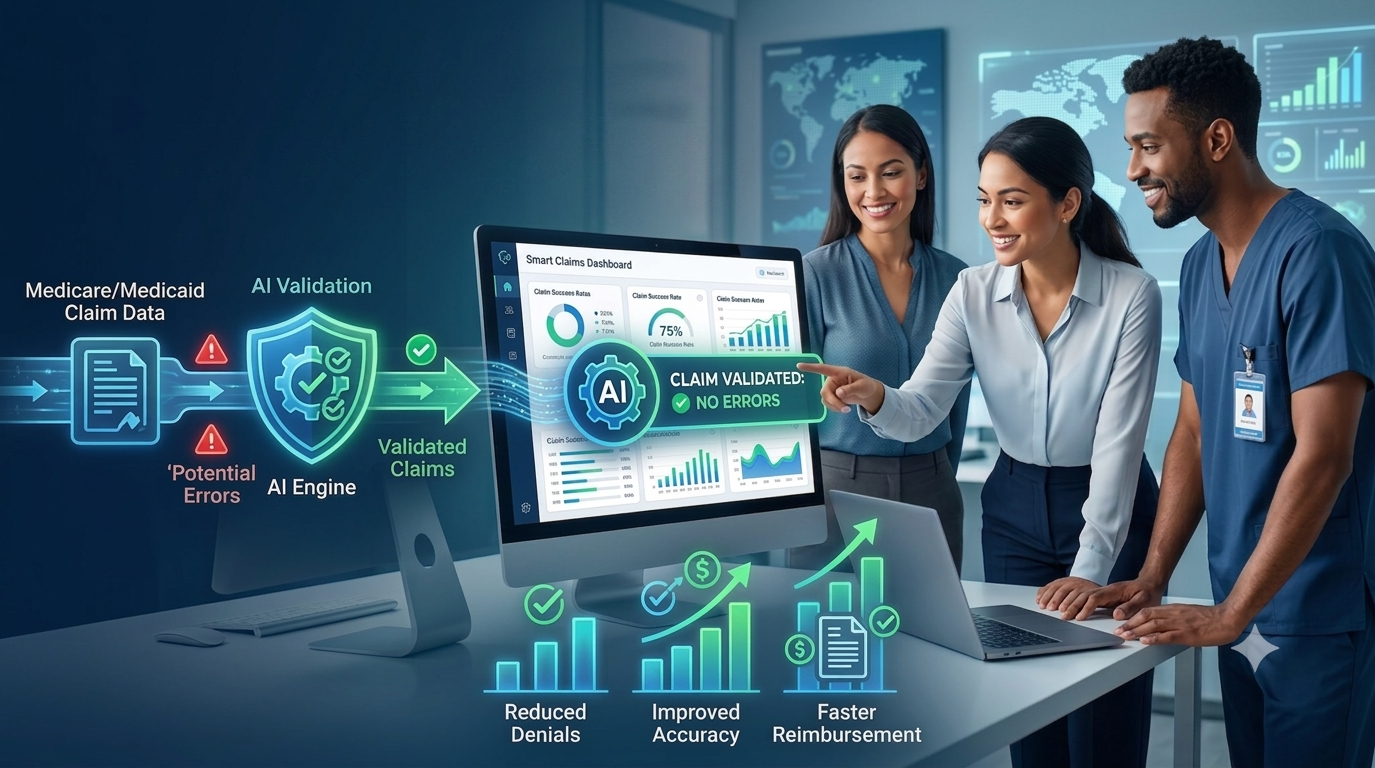
AI-powered validation helps billing teams review claims against multiple checkpoints before they are submitted. Instead of manually reviewing every record, AI can quickly identify missing information, inconsistent data, invalid billing codes, duplicate records, and documentation gaps that result in rejections.
For organizations managing public health plans, AI can help verify compliance with strict payer-specific requirements and state-specific billing rules. By continuously validating claim data against these parameters, AI reduces the risk of preventable errors while improving claim quality.
This proactive approach increases the likelihood of first-pass claim acceptance, shortens reimbursement cycles, and reduces the time spent correcting and resubmitting claims. Rather than reacting to denials after they occur, healthcare organizations can focus on preventing them from happening in the first place.
Beyond Automation: How AI Learns and Improves Over Time
One of the biggest differences between traditional automation and Artificial Intelligence is the ability to learn from experience. Traditional systems follow predefined rules, while AI can analyze historical billing data, recognize recurring patterns, and continuously improve its recommendations over time.
For example, when similar billing issues occur repeatedly, AI can identify the underlying pattern and highlight it earlier in the preparation process. This helps billing teams resolve recurring mistakes more efficiently and reduces the likelihood of repeating the same errors.
AI also provides valuable insights by identifying trends across claims, specific managed care organizations (MCOs), and service types. Instead of reviewing thousands of records manually, billing teams can quickly understand where errors are occurring most frequently and take corrective action to improve future claim quality.
By combining rule-based validation with continuous learning, AI helps healthcare organizations build a more intelligent workflow that becomes stronger as more data is processed.
Benefits of AI-Driven Claim Processing
As healthcare organizations continue to manage increasing claim volumes and evolving government requirements, AI is becoming an important tool for improving the efficiency and accuracy of processing. By combining intelligent automation with data-driven insights, AI helps billing teams work more effectively while reducing unnecessary administrative effort.
Some of the key benefits of AI-driven claim processing include:
- Reduced Claim Denials: Identifies potential errors before claims are submitted, helping prevent avoidable rejections from government payers.
- Improved Claim Accuracy: Validates data and supports consistent, high-quality claim preparation aligned with federal guidelines.
- Faster Reimbursements: Cleaner claims increase the likelihood of first-pass acceptance and shorten payment cycles.
- Lower Administrative Workload: Automates repetitive validation tasks, allowing billing teams to focus on higher-value activities rather than manual compliance screening.
- Better Compliance: Helps organizations stay aligned with changing Medicare rules, state Medicaid policies, and EVV mandates.
- Actionable Insights: Provides visibility into claim trends, recurring payer issues, and performance metrics to support continuous improvement.
By integrating AI into claim processing, healthcare organizations can create a more efficient workflow that improves financial performance while supporting better operational outcomes.
Conclusion
Artificial Intelligence is transforming Revenue Cycle Management by helping healthcare organizations process Medicare & Medicaid claims more accurately, efficiently, and proactively. Rather than replacing billing professionals, AI serves as a valuable support tool that reduces manual effort, improves claim quality, and helps identify potential issues before they impact reimbursement.
As government claim processing becomes increasingly complex, adopting AI-driven technologies can help organizations strengthen their revenue cycle, reduce preventable rejections, and improve overall operational efficiency. By combining human expertise with intelligent automation, healthcare providers are better equipped to navigate today’s evolving reimbursement landscape and deliver sustainable financial outcomes.
